

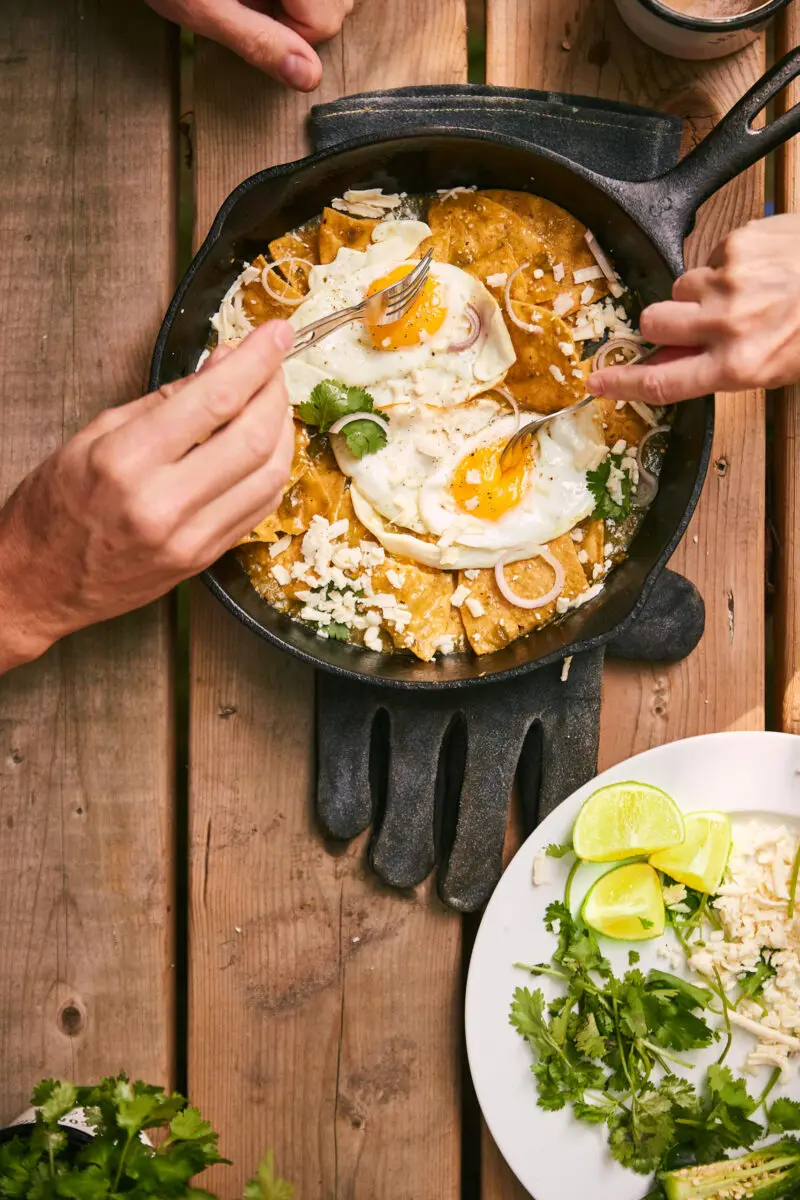
The first time I saw chilaquiles verdes on a Mexican buffet — in the middle of a yoga retreat, of all places — I wondered why anyone would serve nachos at breakfast. One bite in, I was both disappointed and completely won over.
Disappointed because the corn chips were limp, as though the whole thing had been made the night before. Won over by the idea itself. I ate chilaquiles in a lot of other places after that, and it became el amor. This is my version, and the whole point of it is timing.
❤️ Why You’ll Love This Campfire Chilaquiles Verdes
- Ready in about nine minutes — two minutes of prep, seven over the heat, so it never eats into the morning.
- One pot plus a second pan — a cast iron pan and a grate are the whole equipment list, no oven, no extra dishes.
- Rescues the bag of chips someone crushed in the cooler — nothing in the food box goes to waste.
- Works with homemade or jarred salsa verde — five minutes at home, or a jar dropped straight into the cooler.
- Eats well at any hour — breakfast in Mexico, dinner at the fire, and it sits right alongside our corned beef hash and eggs as a camp breakfast in heavy rotation.
- Flexible on top — a fried egg, refried beans or shredded chicken all work if you would rather skip the eggs.
🌮 What Are Chilaquiles Verdes?
Corn tortilla chips turned in hot salsa — green salsa here, made from tomatillos — and served straight away with something rich on top: a fried egg, queso fresco, sour cream. In Mexico it is breakfast, or the thing you eat the morning after. It is also, not coincidentally, the perfect campsite meal: one pot, seven minutes, and it uses up the bag of chips someone crushed in the cooler.
🥚 Green or Red?
Verdes means green — tomatillos, jalapeño, cilantro and lime. Rojos uses a red tomato and dried chili salsa: deeper, smokier, a little sweeter. Same technique, different sauce. There is also divorciados, where half the plate gets each, for people who cannot decide.
I lean green more often than not — tomatillos keep it bright and a little sharp, which is exactly what a plate of fried carbs and melted cheese needs at seven in the morning.
🔥 Cooking Them Over a Fire
You need two heat sources going at once: the salsa warming in a pot, the eggs frying in a second pan. Over a campfire, that means the pot near the coals and the cast iron pan on the grate — or one on the fire and one on the camp stove.
Get everything to the finish line together. The salsa hot, the eggs nearly set, the plates out and the toppings open. Then the chips go in.
Sort your mise en place before either pan goes on the heat: chips within reach, toppings out of their containers, plates ready. Chilaquiles reward a cook who is organized and punish one who is not — there is no simmering something a little longer to buy yourself time once the chips hit the salsa.
🌽 Tortillas or Store-Bought Chips
Real chilaquiles start with tortillas, not chips: corn tortillas cut into wedges and fried in oil until they crisp and blister at the edges. That is still the way to go at home, with a stack of tortillas and nowhere else to be. At the campsite, a bag of sturdy corn tortilla chips does the same job in a fraction of the time — which is the entire reason this recipe exists in my camp kitchen at all.
Either way, go unsalted or lightly salted and skip the thin, delicate chips — they dissolve the second they hit hot salsa, and a dish that already gets salty from cheese and hot sauce does not need help from the chips too. If you are frying your own wedges, do that step before anything else touches the fire: they hold their crunch fine once cooled and drained, so you can get it out of the way and give the salsa and eggs your full attention when the timing actually matters.
🧑🍳 Manon’s Tips for Cooking Chilaquiles Over the Fire
- Coat the chips last, always. They go into the hot salsa only once everything else is staged — plates out, eggs nearly set. More than about a minute in the sauce and you have breakfast nachos soup.
- Build two heat zones and get them there together. Pot of salsa near the coals, pan for the eggs on the grate — see our guide to the two fire cooking methods if you are not sure which spot on the fire does what.
- Buy sturdy chips. Unsalted or lightly salted and thick enough to hold up — thin salted ones dissolve and the dish turns too salty once the cheese lands.
- Bring the salsa verde already made. It keeps a week in the cooler and only gets better after a day, so it is the one part worth doing at home.
- Tear the cilantro instead of chopping it. It keeps the leaves from bruising and wilting into the hot chips before anyone sits down.
- Work off embers, not open flame. A pot or pan straight over flame scorches on one side before the salsa is properly hot — pull coals to the side, or wait for the fire to burn down to a steady bed first.
- Decide your egg doneness on purpose. I like the yolk still soft, but if you are cooking for kids or anyone who prefers eggs fully set, USDA guidance on safe egg temperatures is worth a look before you plate.
🧀 The Toppings
None of this is complicated, and none of it is optional — the toppings are what turns coated chips into an actual finished plate.
- Queso fresco — or crumbled feta, which travels better and tastes close enough.
- A fried egg per plate, yolk still soft.
- Raw or pickled onion, for the sharp note that cuts the richness.
- Fresh cilantro, torn rather than chopped.
- Sour cream and hot sauce, to taste.
🍽️ Serving and Sides
Chilaquiles are a plate, not a spread — everything goes on top, and you eat it standing by the fire if that is where you happen to be. Build each plate the same way every time: coated chips first, then the egg, then cheese, onion and cilantro, and let people add their own sour cream and hot sauce so nobody has to negotiate spice level for the whole table. I keep coffee going alongside, or something cold if it is a hot morning — more about camp ritual than anything the dish itself needs.
Serve it the second it is plated. Left to sit even a few minutes, chilaquiles go from a crisp-soft contrast to a warm, uniform mush, and there is no fixing that once it happens — which is the entire argument for getting the salsa, the eggs and the plates ready before the chips go anywhere near the pot.
🥫 Salsa Verde: Homemade or Store-Bought?
Homemade is better and takes five minutes at home: tomatillos, onion, jalapeño, cilantro, lime, salt. But a jar of decent salsa verde in the food box is one of the best trades in fire cooking — it turns a bag of chips into a hot meal. I bring both when I can.
The method is blunt on purpose: tomatillos, onion, jalapeño, cilantro and lime juice into a food processor, salt to taste, done. Canned tomatillos work as well as fresh here — husked and simmered is the whole point of canning them in the first place — so do not feel obligated to hunt down fresh ones if the canned aisle is what is in front of you. Taste before you add the last of the salt: the lime and the jalapeño both swing the balance, and a salsa that tastes a touch too sharp on its own mellows out fast once it meets hot chips and melted cheese.
❄️ Storage
Chilaquiles do not keep — that is the nature of the dish. The salsa verde, on the other hand, keeps a week in the cooler and gets better after a day.
Keep the salsa in a sealed jar or container rather than the pot you cooked it in, and give it a stir before reheating — it separates a little as it sits. The chips keep best in their own sealed bag, away from the cooler’s damp air, right up until the moment they meet the salsa.

Campfire Chilaquiles Verdes
Equipment
- Cast iron skillet or pot
- Second pan for the eggs
Ingredients
Salsa Verde
- 798 g tomatillos canned or fresh
- 1 onion finely chopped
- 1 jalapeño chopped, to taste
- 1 small bunch of cilantro
- 1 tbsp lime juice
- 1 pinch salt
Chilaquiles
- 375 ml salsa verde homemade or store-bought
- 2 eggs
- Olive oil
- 200 g corn tortilla chips unsalted or lightly salted
- To serve queso fresco or feta, cilantro, chopped onion, sour cream, hot sauce
Instructions
- Heat the salsa verde in a pot for a few minutes.
- Meanwhile, set a second pan over the heat to fry the eggs in olive oil.
- As soon as the eggs are in the pan and the salsa is hot, tip the tortilla chips into the pot and turn them until they are well coated.
- Transfer the coated chips to two serving plates.
- Top each with an egg, queso fresco or crumbled feta, a few cilantro leaves, some onion — raw or pickled — sour cream and hot sauce to taste.
- Serve immediately, while the chilaquiles still have some crunch left.
Notes
- Tortillas instead of chips
- What tomatillos are
- How spicy it is
- Making it without eggs
- Preparing anything in advance
- What chips to buy
- Breakfast or dinner
- Verdes vs rojos
- How many it serves
- Cooking it without a campfire
❓ Frequently Asked Questions
Can I use tortillas instead of chips?
Yes, and it is the traditional way: cut corn tortillas into wedges and fry them in oil until crisp, then proceed. Chips are the shortcut that makes this a campsite recipe.
What are tomatillos?
Small green fruit in a papery husk, tart and slightly citrusy. They are not unripe tomatoes. Canned ones work perfectly well and are easier to carry.
How spicy is it?
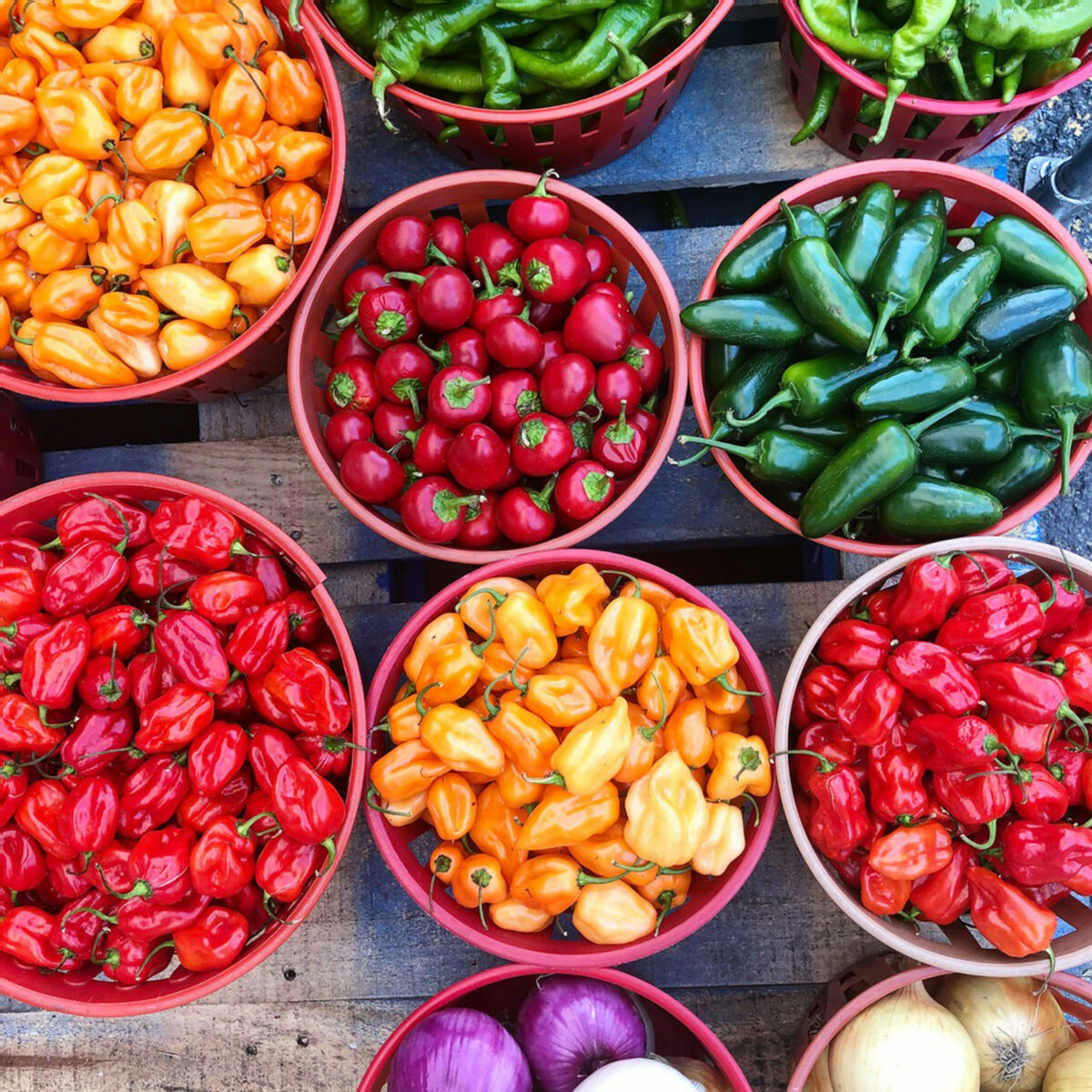
As spicy as your jalapeño. Seed it for mild, leave the seeds in for heat, or use two.
Can I make it without eggs?
Yes. Refried beans, shredded chicken or just the cheese and cream are all traditional toppings.
Can I prepare anything in advance?
The salsa verde, absolutely — make it at home and bring it in a jar. Everything else happens in the last five minutes.
What kind of chips should I buy?
Unsalted or lightly salted, and sturdy. Thin salted chips dissolve in the sauce and make the dish too salty once the cheese goes on.
Is this breakfast or dinner?
In Mexico, breakfast. Away from a kitchen, whenever people are hungry — it works at every hour.
What’s the difference between chilaquiles verdes and rojos?
The salsa. Verdes is built on tomatillos, jalapeño, cilantro and lime — bright and tart. Rojos swaps in red tomatoes and dried chilies for something deeper and a little sweeter. Divorciados splits the plate between the two for anyone who cannot decide.
How many does this recipe serve?
Two, as written — plenty for a quick camp breakfast for two, or one very hungry cook.
Do I need an actual campfire to make this?
No. At home, a pot on the stove and a skillet next to it do exactly the same job as the fire and the grate. If you are building the fire from scratch, our guide to building a fire covers getting it to a steady bed of coals before you start cooking.
Lionel
Wednesday 18th of January 2023
Great recipe!