

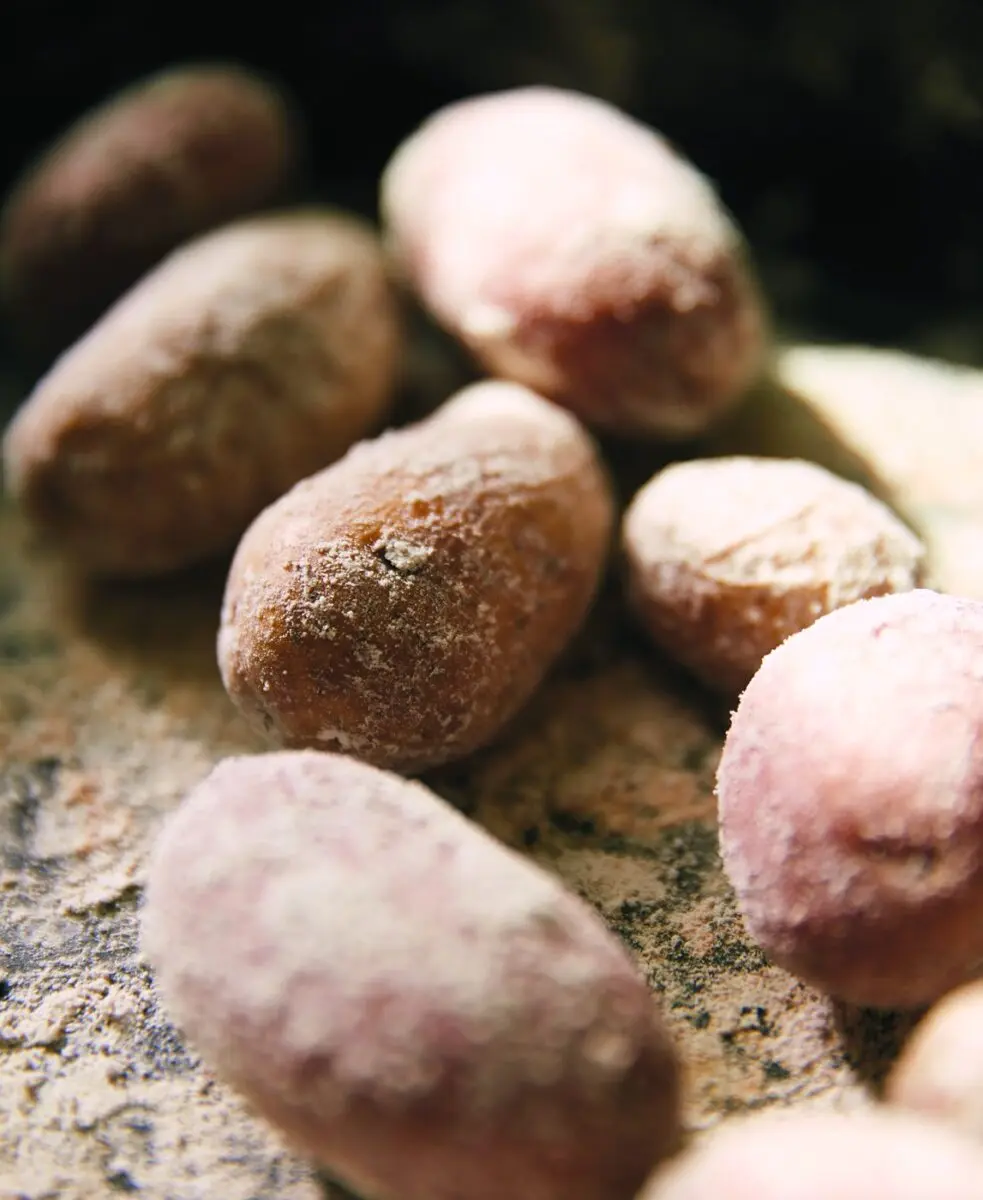
In the Canary Islands, this dish is called papas arrugadas — wrinkled potatoes — and if you ever meet me in person, don’t use that word to describe me directly, unless you’re prepared to order your own pizza for dinner.
I fell for this technique years ago because it turns a five-ingredient camp staple into the kind of dish people stop mid-conversation to ask about. Traditionally, papas arrugadas are boiled right in seawater, which tells you everything about how they’re meant to taste — briny, tender, wrapped in a crackling, salt-white skin. If you’re camping on a beach or taking the boat out, do exactly that and skip the added salt. Everyone else fakes it with a very salty pot of fresh water, and the result is just as good.
These salt-crusted potatoes are simple on paper — potatoes, salt, water — but the science and the timing matter more than you’d think. I’m covering why the skin wrinkles, which potatoes work, how to read the pot so you don’t end up with mush or an inedible salt lick, and the two Canarian mojo sauces that make the whole thing sing. Skip straight to the recipe card if you just want the numbers; stick around if you want to understand what’s happening in that pot.
🌊 Why the Canary Islands Boil Potatoes in the Sea
Papas arrugadas started as a fisherman’s dish on islands like Fuerteventura and Lanzarote, where fresh water was scarce but the Atlantic was right there. Boiling potatoes in seawater wasn’t a flavor choice at first, it was simply the water available. It turned out to be a happy accident: seawater’s salt concentration, around 3.5 percent, is close to what you want to season a potato all the way through without making it inedible.
Camping puts you in a similar spot, working with a limited pot, a live fire, and ingredients that need to pull double duty. I make these constantly at inland campsites nowhere near an ocean, using nothing but table salt and a jug of water, and nobody has ever told me they weren’t authentic enough.
🧂 The Science Behind Salt-Crusted Potatoes
Here’s what actually happens in a pan of salt-crusted potatoes.
Potato skin is semi-permeable — water moves through it toward wherever the salt concentration is higher, balancing things out on both sides. In plain water, that pull barely exists, so the potato just boils and stays smooth. In a very salty brine, water gets pulled out of the potato’s outer layer, through the skin and into the pot, faster than the skin can shrink to match it.
The skin dries out, tightens, and buckles into those characteristic ridges, while the inside stays moist and dense, since the salt never has time to fully penetrate past the first few millimeters. That’s also why you finish them low and slow once most of the water has boiled away: you’re not really cooking the potato anymore at that point, you’re finishing the dehydration of the skin so it wrinkles instead of sitting there wet and salty.
🥔 Picking the Right Potato
Fingerling potatoes are the right call here, in yellow, red, or a mix of both — small, waxy, and thin-skinned enough that the ridging actually shows once they dry out. Waxy potatoes also hold their shape through a hard boil, where a starchy russet would just fall apart into the salted water. If you can’t find true fingerlings, look for any small waxy potato, roughly egg-sized or smaller. Cut anything bigger than a golf ball in half so it cooks through at the same rate as the rest.
- True fingerlings, yellow, red, or both. My first choice, and what this recipe is built around.
- Baby yellow or new potatoes. Similar size and waxy texture; wrinkle almost as well.
- Starchy potatoes like russets. Skip these — they break apart before the skin gets a chance to wrinkle.

🍳 Gear You Need at Camp
This whole recipe runs on one pan: a large, heavy skillet with a lid, or any big pot wide enough to hold every potato in a single layer, since a piled-up second layer cooks unevenly and steams instead of wrinkling. Cast iron holds heat evenly over coals, which helps once you’re down to that final low, dry simmer. For the sauces, a mortar and pestle gets you closer to the traditional texture, but a food processor works fine at home before you leave — more on that below.
🔥 Cooking Salt-Crusted Potatoes Over the Fire
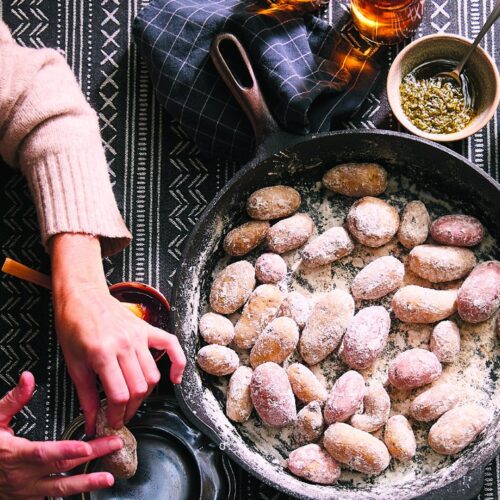
Salt-crusted potatoes start the same way every time. Set the potatoes in your pan in a single layer, add the sea salt, then pour in just enough salted water to cover them — about a liter, depending on your pan and how many potatoes you’re working with.
Bring it to a full boil over the hottest part of the fire and let it boil hard, watching for two things: the potatoes turning tender when pierced, and the water level dropping. If the potatoes are nearly done and a lot of water remains, ladle some out rather than waiting — you want the water gone before they overcook.
Once most of the liquid is gone, pull the pan to a cooler spot over glowing coals and finish over low heat a few more minutes, turning gently. Watch the skins go from wet and smooth to dry, taut, and finally wrinkled — that’s your cue to pull them.
🌶️ Two Sauces, Two Moods
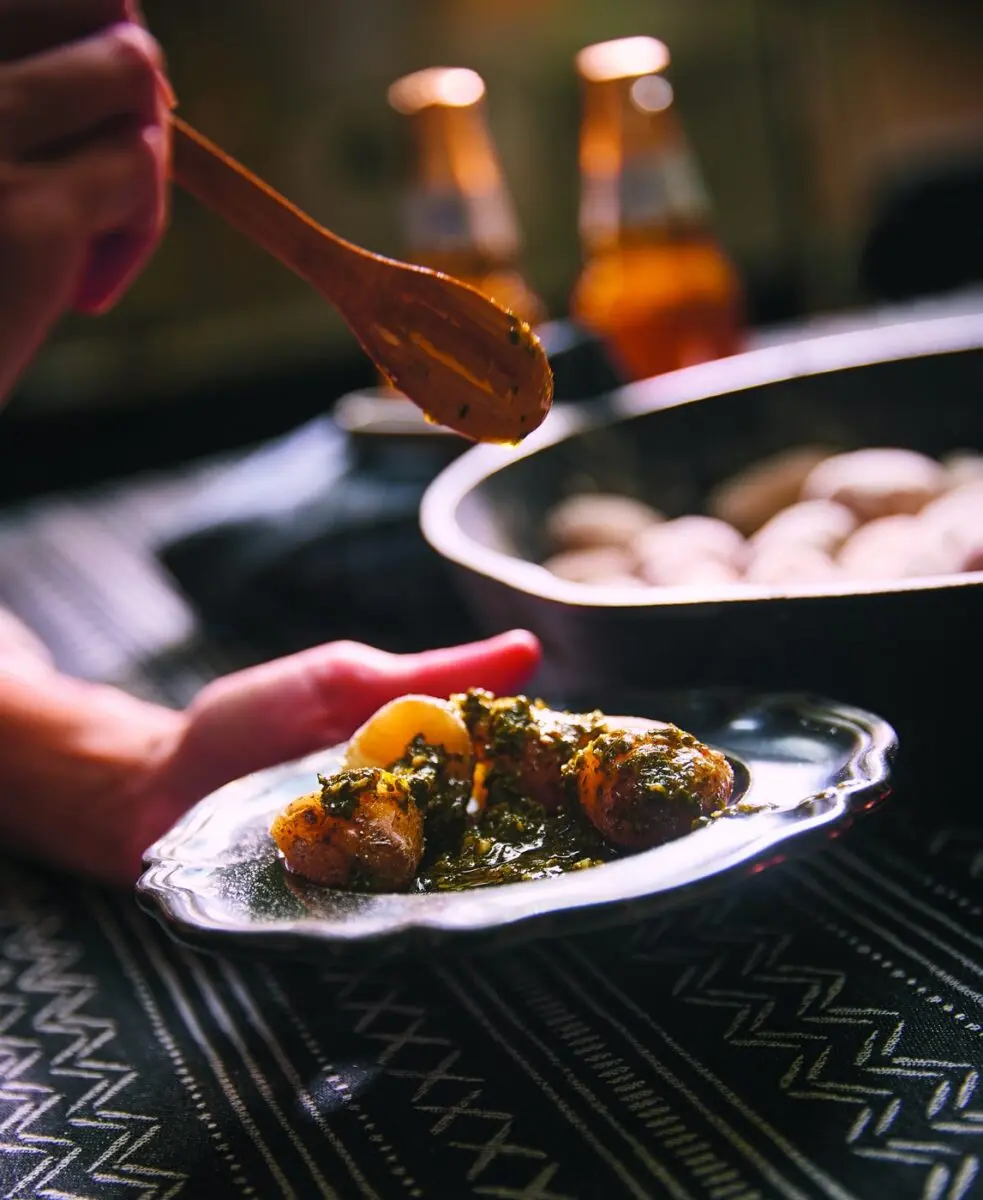
Papas arrugadas don’t really exist without mojo, and Canarian cooks pick sides between the two classic versions. Mojo rojo is built on dried ancho-style chiles and roasted red pepper, blended with paprika, cumin, garlic, and vinegar into something smoky and sharp. Mojo verde swaps the char for freshness — garlic, jalapeño, and a full bunch of cilantro pounded into a paste, loosened with olive oil until it’s closer to a pesto than a salsa. I make both, since guests always split down the middle, and because leftover mojo verde is one of the best things you can put on eggs the next morning.
🏕️ Serving and Sharing
Pile the potatoes straight into the pan or a bowl, skins on, with both sauces alongside for dipping — this is a hands-in, pass-it-around dish, not a plated one. People ask what they are before they ask how to eat them; the wrinkled, matte-white skin doesn’t look like much until someone breaks one open and hits that dense, creamy interior. I usually serve these as a shared starter while something bigger finishes over the fire.
🧊 Salt-Crusted Potatoes: Leftovers and Make-Ahead
Salt-crusted potatoes are best straight from the pan, so the mojo sauces are the real make-ahead move here — both keep well in a sealed jar in the cooler for four or five days, and the flavor only gets better after a day to sit. The potatoes are best fresh off the fire while the skin is still crisp, since it softens back up once refrigerated. Leftovers reheat fine in a hot, dry pan, though you won’t get the same crackle the second time around.
Salt-Crusted Potatoes
Equipment
- 1 large skillet or pot with a lid, wide enough to hold the potatoes in a single layer
Ingredients
For the Potatoes
- 2 lb Fingerling potatoes yellow, red, or a mix of both
- 1/2 tsp sea salt
- 1 liter water with 2 tbsp + 1 tsp of salt (or ideally 1 liter of seawater!) keep the same ratio if you need more water
For the Mojo Rojo Sauce
- 2 cloves garlic
- 2 dried ancho-style chiles
- 1 red bell pepper, grilled, peeled, and seeded
- 2 tsp paprika
- 1 tsp cumin
- 2 tbsp red wine or sherry vinegar
- 1 pinch salt generous
For the Mojo Verde Sauce
- 2 cloves garlic
- 1 jalapeno, seeded
- 1 tsp salt
- 1 bunch fresh cilantro, leaves picked
- 1 tsp cumin
- 1/2 cup olive oil
- 1 tbsp red wine or sherry vinegar
Instructions
Make it ahead
- Combine all the mojo rojo ingredients in a mortar or a jar of at least 500 ml (2 cups). Blend with a pestle or an immersion blender until you have a fairly liquid sauce.
- For the mojo verde, mash the garlic, jalapeno, and salt into a paste in a mortar.
- Add the cilantro leaves and crush well into the paste with the pestle.
- Add the cumin, then drizzle in the olive oil gradually, working it in until you have a smooth, pesto-like sauce.
- Stir in the vinegar with a fork to combine. Store both sauces in sealed jars until you leave.
Over the fire
- Place the potatoes in a large pan or skillet, in a single layer.
- Add the sea salt, then cover the potatoes with just enough salted water (about 1 L, depending on the size of your pan and potatoes).
- Bring to a boil, then cook at a hard boil until the water has evaporated or the potatoes are cooked through. If the potatoes are nearly done and a lot of water remains, ladle some out.
- Reduce to low heat and continue cooking a few more minutes, gently turning the potatoes, until they are dry and the skins begin to wrinkle.
Notes
- What papas arrugadas are
- Making it without a campfire
- Whether fingerling potatoes are required
- Using real seawater instead of salted water
- Knowing when potatoes are done
- Making the mojo sauces ahead
- What to serve alongside
❓ Frequently Asked Questions
What are papas arrugadas?
Salt-crusted potatoes are a traditional Canary Islands dish of small potatoes boiled in very salty water — often actual seawater — until the skin dries into a wrinkled, salt-crusted layer around a creamy interior. They’re almost always served with mojo rojo or mojo verde for dipping.
Can I make this without a campfire?
Yes — a stovetop or camp stove burner works exactly the same way. Just manage the heat the way you would over coals: a hard boil to start, then a low simmer once the water is mostly gone.
Do I really need fingerling potatoes?
You want a small, waxy potato either way, so any baby or new potato of similar size will wrinkle up almost as well. Starchy potatoes like russets tend to fall apart before the skin has a chance to dry and ridge.
Can I use real seawater instead of salted tap water?
Absolutely, and it’s actually the traditional method if you’re beach camping or out on a boat. Just taste it first, since salinity varies by location, and skip any added salt if you do.
How do I know when the potatoes are done?
Pierce one with a knife — it should slide in with almost no resistance. The final wrinkled skin only shows up after the water has evaporated and you finish them a few extra minutes over low heat.
Can I make the mojo sauces ahead of time?
Yes, and I’d recommend it — both sauces keep well for four or five days in a sealed jar in the cooler, and the flavor actually improves after a day.
What do I serve alongside these potatoes?
They work best as a shared starter with both sauces set out for dipping, alongside something bigger finishing on the fire. Leftover mojo verde is also great on eggs the next morning.