

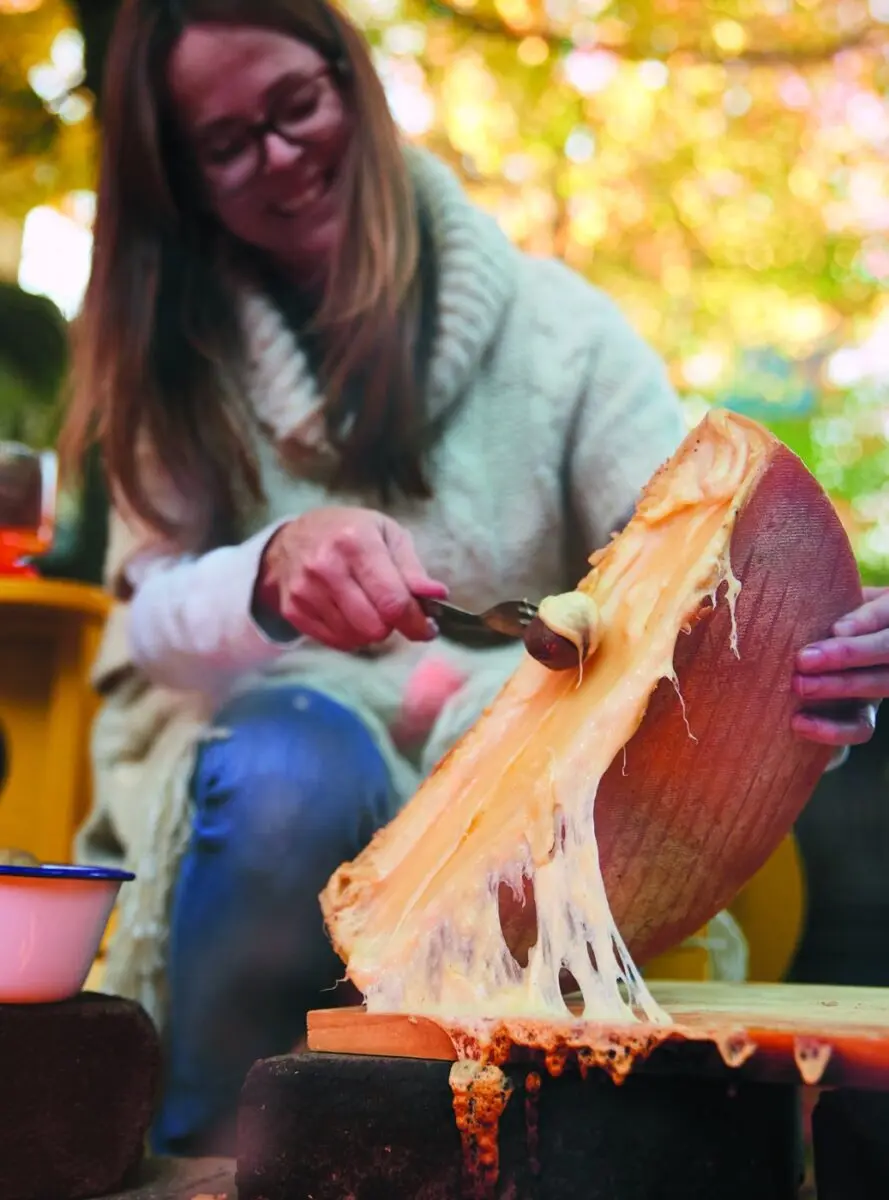
Raclette is a fixture at the chalet, but people forget it works just as well outside those walls — over a campfire, on the barbecue in the backyard, in front of the fireplace on a night too cold to sit outside. Cooking it outdoors solves the one real problem with raclette: the smell. A pan of melting cheese going for three hours fills a cabin fast. Do the same thing over open flame, with everyone gathered close waiting for the next scrape, and the smell becomes part of the fun instead of a problem to manage. Fireside raclette has been part of my outdoor cooking for years now, and I’m not going to hand you a fussy, measured-out recipe for it. I want to show you how it actually gets done, so you can build your own version of the night.
There’s no single correct way to melt raclette by the fire — I use three, depending on the crowd, the gear I’ve hauled along, and how patient everyone’s feeling. Below you’ll find the traditional Swiss method, where a half-wheel of cheese melts at the fire’s edge and gets scraped as it goes; the barbeclette version, built for a group and a grill; and the fast griddle version for when nobody wants to wait. After that: what goes on the board, how to actually serve this thing, and what to do with what’s left.
🧀 Why Fireside Raclette Belongs Outside the Chalet
Most people know raclette as an indoor, wintertime, ski-chalet dish — a machine on the table, little trays of cheese, everyone hovering close. It’s just as good cooked outside, arguably better. Open air handles the smell a closed room can’t, a real fire gives you heat you can actually read instead of an electric dial, and there’s something about gathering around live flame, waiting your turn with the scraper, that a tabletop machine can’t replicate. This isn’t a camping-only trick, either — the same setup works over a backyard fire pit, a barbecue grate, or a fireplace hearth on a night you’re not going anywhere. Wherever you’ve got fire and a grate, you’ve got raclette.
🔥 The Traditional Way: A Half-Wheel at the Fire’s Edge
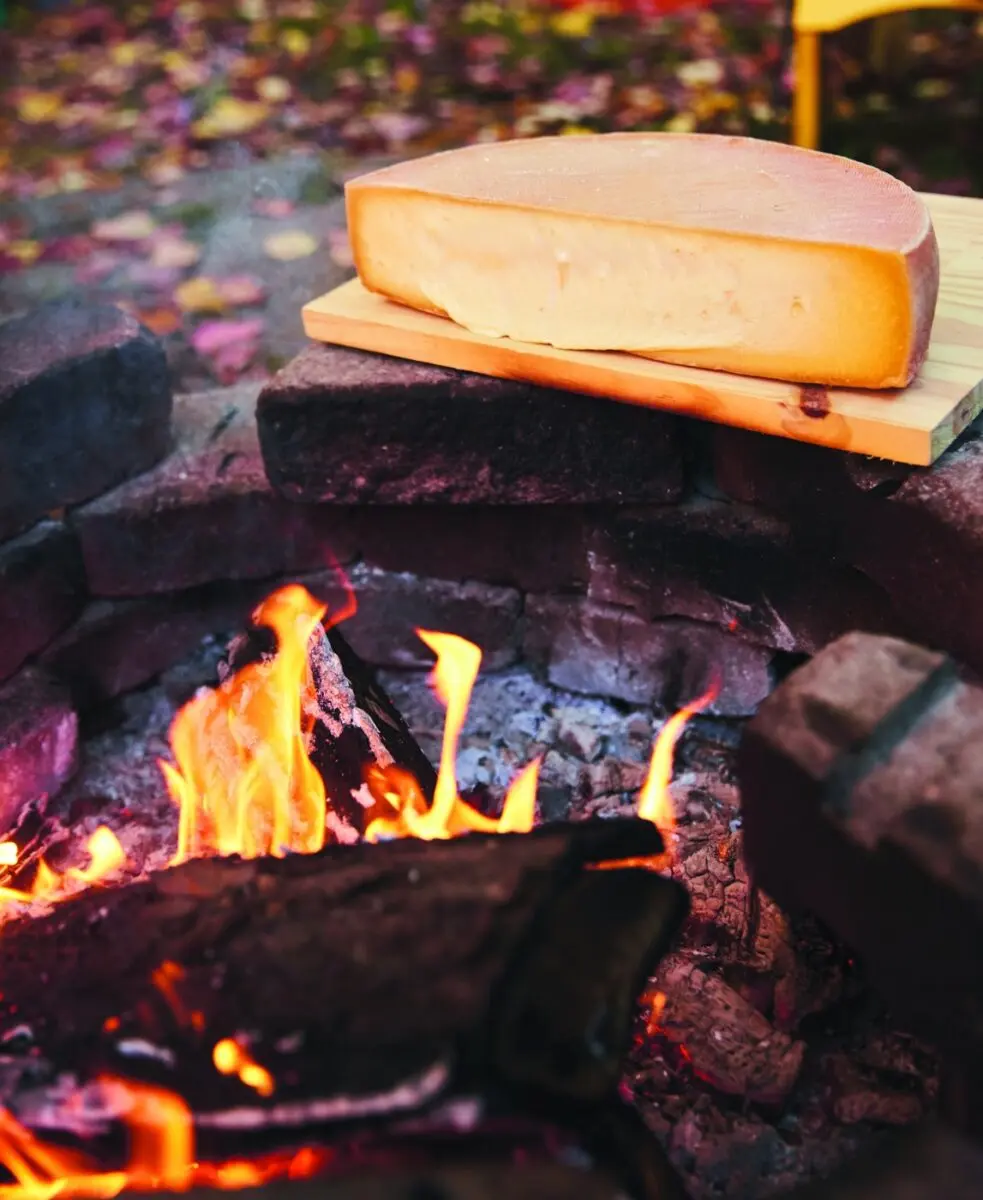
Here’s a question I get asked constantly: most raclette machines melt the cheese from above, under a little heating element. So how do you melt it from below, over a fire, and get the same result? The answer is that the direction doesn’t actually matter — what matters is that raclette, made the way it’s traditionally done in Switzerland and Savoie, is meant to melt gently, not brown or bubble hard. The traditional method is to set a half-wheel of raclette cheese at the edge of the fire — close enough to melt, never in the flames — and scrape off the melted layer as the evening goes on. That’s genuinely where the name comes from: racler, to scrape. You’re not cooking one batch and serving it all at once; you’re scraping a little at a time, all night, which is exactly why raclette turns into an event instead of a meal.
🍗 Barbeclettes: Little Pans for a Crowd
If you’ve got a group and want everyone melting their own cheese at the same time, barbeclettes — small individual raclette pans built for the grill — are the move. We own four and love them, though honestly two would probably do; raclette is a marathon, not a sprint, and people don’t all want their cheese at once. Lay a slice of raclette in the non-stick side of the pan, set it on the campfire grate or the barbecue, and watch it closely — melted cheese goes from perfect to burnt fast. Once it’s bubbling, use the little spatula that comes with it to slide the melted cheese straight onto a plate.

🍳 The Lazy Version: Griddle or Flat-Top
When everyone’s starving and nobody wants to wait their turn at a half-wheel, I pull out what I call my lazy-person’s raclette: slices of cheese melted directly on a hot griddle or flat plate set over the grate. It’s less theater and more throughput — melt, scrape onto plates, repeat. It’s not the classic version, but it gets a hungry group fed fast, and it works just as well on a stovetop griddle at home as it does outside.
🥚 Building the Board
Raclette isn’t really about the cheese alone — it’s about what it lands on. Build the board before the cheese starts melting, so it’s ready the second the first scrape happens:
- Potatoes. Small grelot or fingerling potatoes, steamed, cooked in foil, or fried — cooked through and hot when the cheese hits them.
- Pickles. Cornichons and other marinated vegetables to cut the richness of the cheese.
- Vegetables. Cauliflower, mushrooms, bell peppers — raw, roasted, or grilled.
- Cured meats. Viande des grisons, dried duck breast, prosciutto, bacon — whatever charcuterie you’ve got.
- Country bread. For scraping cheese onto once the potatoes run out.
- A green salad. Something sharp to balance the richness.
🍽 How to Serve It
Raclette is meant to be slow. Put the board out, start melting cheese by whichever method you’ve picked, and let people build their own plates as the scrapes come — a bit of potato, a slick of melted cheese, a pickle, a piece of charcuterie, repeat. Nobody plates a full meal at once; it’s a graze that goes on for an hour or two. I always finish the night with a pot of herbal tea — raclette is a lot of rich cheese, and tea helps settle things once everyone’s had their fill. Pour a crisp white wine while you’re eating — a Riesling or Grüner Veltliner holds up well against the fat of the cheese.
🏠 At the Chalet, the Backyard, or the Campsite
This is a dish that moves. At the chalet, it’s the obvious choice — cook it over the hearth or a fire pit outside instead of the usual tabletop machine. At home, your backyard barbecue does the job of a campfire grate just fine, and a fireplace works for the half-wheel method on a night you’re staying in. At an actual campsite, pack the barbeclettes if you’ve got room, or bring a griddle and a bag of pre-sliced cheese if you’re keeping things light. The method bends to whatever fire you’ve got in front of you.
❄️ Leftovers
Raclette doesn’t really produce leftovers in the usual sense — you scrape and eat as you go, not in batches. If you’ve got unmelted cheese left over, wrap it well and it keeps in a cooler or the fridge like any other cheese. Leftover board items — potatoes, charcuterie, pickles — make a decent lunch the next day, though the magic of the melt doesn’t really reheat; cold raclette potatoes with cheese are fine, but they’re not the same dish.
Fireside Raclette
Equipment
- barbeclettes (individual raclette pans for the grill) for the crowd version
- wooden board and a spatula or the back of a knife for the traditional half-wheel method
- griddle or flat plate for the fast version
- campfire, barbecue, or fireplace grate
Ingredients
The Cheese
- raclette cheese in pre-sliced packs, or a half-wheel for the traditional method
For the Board
- grelot or fingerling potatoes steamed, cooked in foil, or fried — or french fries (melted cheese on french fries is the absolute BEST)
- cornichons and other pickled vegetables
- vegetables such as cauliflower, mushrooms, bell peppers
- cured meats such as viande des grisons, dried duck breast, prosciutto, or bacon
- country bread
- green salad
To Finish
- herbal tea to help with digestion after the meal
Instructions
Build the Board
- Arrange the potatoes, pickles, vegetables, cured meats, bread, and salad on a large board or platter before you start melting cheese, so everything is ready the moment the first scrape happens.
Option 1 — Barbeclettes
- Lay a slice of raclette cheese in the non-stick side of each barbeclette pan.
- Set the pans on the campfire grate or barbecue grate and watch closely — melted cheese goes from perfect to burnt fast.
- Once the cheese is bubbling, use the small spatula to slide it straight onto a plate.
Option 2 — Half-Wheel Over the fire’s Edge
- Set the half-wheel of raclette cheese, cut side toward the heat, at the edge of the fire — close enough to melt gently, never in the flames.
- As the surface melts, scrape it off with a spatula or the back of a knife onto a waiting plate or board.
- Keep scraping as the evening goes on, melting and serving a little at a time rather than all at once.
Option 3 — Griddle
- Set a griddle or flat plate over the grate and melt slices of raclette directly on it.
- Scrape or lift the melted cheese off onto plates as soon as it is bubbling.
To Serve
- Let everyone build their own plate as the scrapes come, and finish the meal with a pot of herbal tea.
Notes
- Which cheese to use for raclette
- Whether a raclette machine is needed
- Making raclette on a backyard barbecue
- How much cheese and potatoes per person
- No half-wheel of raclette cheese
- Doing it indoors by a fireplace
- What else to serve with raclette
❓ Frequently Asked Questions
What cheese should I use for raclette?
Real raclette cheese, whether in pre-sliced packs or a half-wheel, is worth seeking out if you can find it. If not, young Gruyère, Comté, Morbier, or fontina melt in a similarly silky way and work as a close substitute.
Do I need a raclette machine for this?
No — that’s the whole point of doing it by the fire. A half-wheel and a board, a set of barbeclettes, or a plain griddle all do the job without any electric equipment.
Can I make raclette on a regular backyard barbecue?
Yes. Barbeclettes and griddles both sit directly on a barbecue grate, and a half-wheel can be propped at the edge of a wood or charcoal fire built in a barbecue just as easily as a campfire.
How much cheese and how many potatoes do I need per person?
There’s no fixed amount — raclette scales to your crowd, your appetite, and how long you want the evening to run. Buy more cheese than feels reasonable; it goes fast once people get into the rhythm of scraping.
What if I don’t have a half-wheel of raclette cheese?
Pre-sliced raclette works in a barbeclette or on a griddle just as well. The half-wheel is really only needed for the traditional scrape-at-the-fire’s-edge method.
Can I do this indoors, by a fireplace?
Yes — the half-wheel method in particular works well propped at the edge of a hearth. Keep it close enough to melt gently, not so close it scorches.
What else can I serve with raclette besides potatoes and charcuterie?
Grilled or toasted bread makes a good stand-in or addition when potatoes run low, and a sharp green salad on the side cuts through all that melted cheese.