

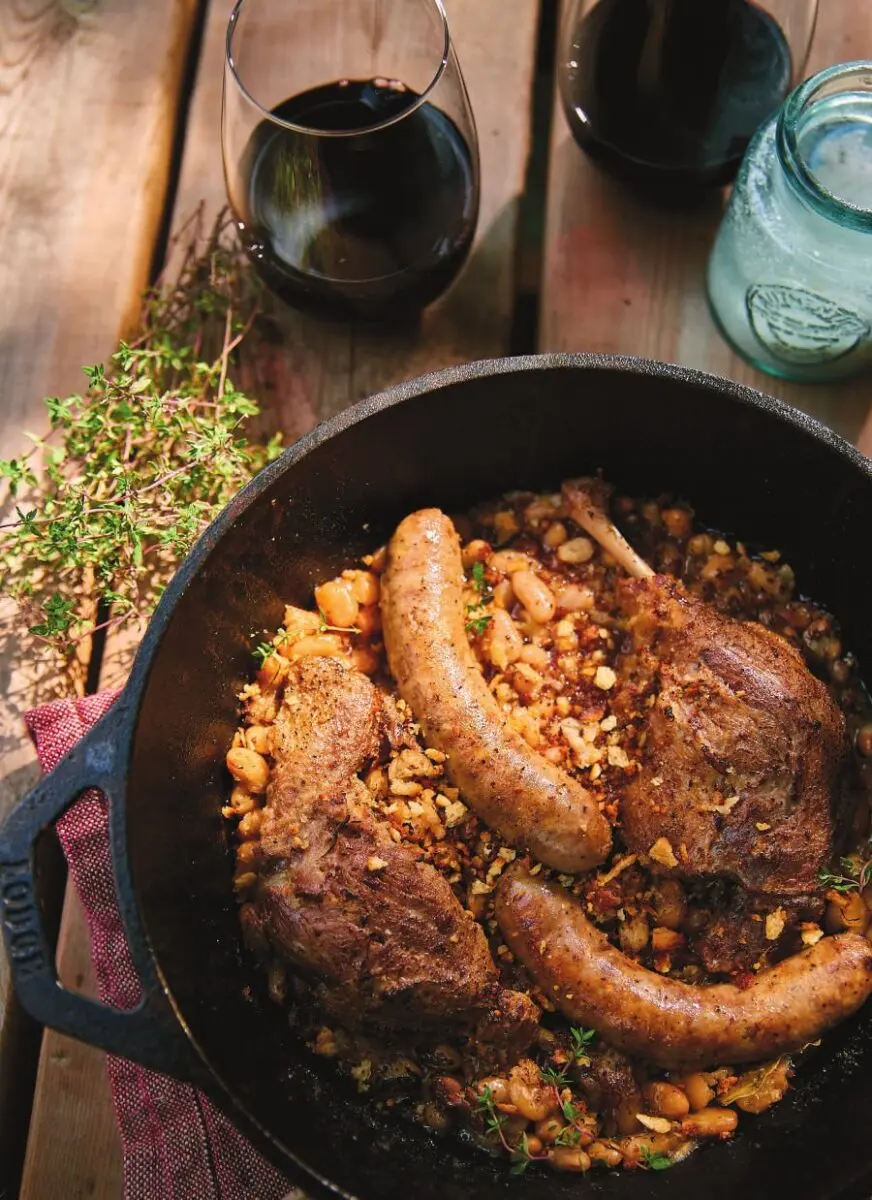
Real cassoulet takes a full day — dried beans soaked overnight, duck confit and pork simmered low and slow until a crust forms, cracks, and gets pressed back in three or four times. I don’t have a full day on the spot, and most nights I don’t have one at home either. Cassoulexpress is my campfire cassoulet shortcut: canned cannellini, confit duck, a couple of Toulouse sausages, and garlic breadcrumbs, all done in one pot in about 35 minutes over the fire. It skips the marathon, not the point of the dish.
Below I’ll walk through why this campfire cassoulet works (and where I refuse to cut corners), what gear you actually need, ingredient swaps if your grocery store doesn’t carry duck confit, and the heat and timing cues I use so the sausage doesn’t overcook while the beans catch up. There’s a printable recipe card, my serving suggestions, and the questions people ask me most about this one.
🍲 Why Cassoulexpress Exists
I adore cassoulet, full stop. I keep a good canned version in my emergency kit at all times, because a can of cassoulet has turned more than one rained-out afternoon into something cozy instead of miserable.
But when I’ve got a working fire and thirty-five minutes, I’d rather make the real-ish thing. Classic cassoulet from the Languedoc leans on three things: beans that have cooked low and slow until they’re creamy, several cuts of pork and duck layered in, and a breadcrumb crust that gets broken and pressed back into the stew again and again as it bakes.
My campfire cassoulet keeps all three priorities, it just compresses the timeline. Canned cannellini give you that creamy texture without an overnight soak. Confit duck gives you the richness without hours of rendering. And the crust still shows up, it just does its job once instead of four times. You lose some depth, sure. You don’t lose the dish.
🏕️ What You’ll Need
A campfire cassoulet needs almost no gear. Keep it simple: a saucepan or a cast iron skillet set directly over the fire, and a wooden spoon so you’re not scratching the pot while you stir. You’ll deglaze with broth, not wine, so nothing fancy needed there either. If you’re cooking over open flame rather than a bed of coals, keep a lid within reach even though the simmer itself should stay uncovered — it’s handy if the flames spike and you need to smother them fast, not for the cooking itself.
🦆 Ingredients and What You Can Swap
A few notes on the ingredients before you shop:
- Cannellini beans, not navy beans. Canned cannellini have a rounder, creamier bite that gets you closest to beans that simmered low for hours — save a third of the can liquid, it helps thicken the stew later.
- Confit duck is the real shortcut. Canned or jarred duck confit legs are already cooked, so all you’re doing is warming them through and flaking the meat into the pot.
- Toulouse sausage, or close to it. It’s a mild, coarse fresh pork sausage — any mild fresh French-style or sweet Italian sausage works as a stand-in, just avoid anything smoked.
- Garlic breadcrumbs do double duty. Make the garlic-toasted breadcrumbs at home before you leave, or toast plain breadcrumbs in oil with crushed garlic on the spot if you forgot.
- Save the duck fat. If your confit duck came in a jar or vacuum pack, keep the fat and any jellied broth in the packaging — sear the sausages in the fat, stir the jellied broth into the pot, and cut back the chicken broth by the same amount.
🔥 Cooking Campfire Cassoulet Over the Fire
Get your fire down to a bed of medium coals, or set your grate over medium-low flame — this isn’t a dish for roaring heat, it scorches the pot bottom before the beans even get warm. Sear the sausages and duck legs first, a few minutes a side, just until lightly browned; the sausages shouldn’t be cooked through yet, they’ll finish in the simmer.
Deglaze with the chicken broth, scraping up whatever’s stuck to the pot, that’s flavor you don’t want to leave behind. Add the beans (plus that reserved bean liquid), garlic, thyme, and bay leaf. Bring it to a boil, then pull it back to a gentle simmer, uncovered, for about 30 minutes, stirring gently now and then so nothing catches.
Those thirty minutes are mine — I crack open the Pschitt and let the pot do its own thing for once. You’re looking for the broth to reduce and thicken a little and the sausage to be firm and cooked through. If you want to be sure rather than go by feel, sausage and duck should hit at least 165°F — FoodSafety.gov’s safe minimum internal temperature chart has the full breakdown by ingredient. If it’s still thin, stir in a spoonful of breadcrumbs at a time — they thicken it fast.
🍞 Building the Crust
Classic cassoulet gets its crust from hours in the oven, breaking and reforming as it bakes. A campfire cassoulet has no oven, so I don’t try to fake one. Instead, the garlic-toasted breadcrumbs go on generously right at the end, just before serving. It’s less a baked crust and more a textural finish, but it does the same job: a crunchy, garlicky contrast against the creamy beans and rich duck. Don’t skip it and don’t add it too early, or it just goes soft in the broth.
🌶️ Variations
Campfire cassoulet takes substitutions well. Swap in lamb shoulder or pork shoulder for some of the meat if that’s what you’ve got. Bacon or pancetta cubes work instead of, or alongside, the duck for a less rich but still savory version. A chopped tomato stirred in adds brightness if the stew is tasting too heavy. And if cannellini aren’t available, any white bean works in a pinch — great northern or butter beans both hold up fine. A glass of red wine added at the start of the simmer deepens the flavor considerably, if you brought a bottle for the pot as well as the table.
🍷 How to Serve It
This campfire cassoulet serves four generously. Pair it with a peppery red wine — a Côtes du Rhône, a Madiran, or a Cahors all work — and crusty bread for sopping up the broth. I serve it straight from the pot at the fire, family style, everyone digging in with their own hunk of bread rather than plating it out.
🧊 Keeping Leftovers
Cool it before it goes in the cooler, and eat it within a couple of days. Reheated on the stove or over the fire, it holds up better than most stews — the beans keep their texture and the duck stays rich instead of drying out.
Cassoulexpress
Equipment
- 1 cast iron skillet
Ingredients
For the stew
- 2 Toulouse sausages raw, uncooked
- 2 confit duck legs pre-cooked, vacuum-packed or canned
- 3/4 cup chicken broth
- 2 cans (14 oz / 398 ml) cannellini beans drained, but keep the liquid aside — you might need it
- 2 cloves garlic
- thyme a few sprigs
- 1 bay leaf
- 1/4 cup breadcrumbs plain, for thickening if needed
For the garlic-toasted breadcrumbs
- 4-6 slices day-old bread
- 3 cloves garlic
- 3 tbsp olive oil
- salt a good pinch
To serve
- garlic-toasted breadcrumbs see the make-ahead steps
- country bread for serving
- red wine optional, for serving
Instructions
Make it ahead
- Make the garlic-toasted breadcrumbs at home, before you leave.
- In a food processor, coarsely chop the bread with the garlic cloves.
- Heat the olive oil in a cast iron skillet. Add the bread and garlic and stir so the oil coats everything evenly.
- Cook over medium heat, stirring regularly, until the crumbs are well toasted, about 15 minutes. Salt to taste.
- Transfer to a paper-towel-lined plate and let cool. If the crumbs still feel damp, let them dry on the counter before storing them in an airtight container.
Over the fire
- In a cast iron skillet over medium coals, sear the sausages and duck legs for a few minutes, until lightly browned on the outside. The sausages don’t need to cook through yet — they’ll finish in the simmer.
- Deglaze the pot with the chicken broth, scraping up any browned bits from the bottom.
- Add the cannellini beans, garlic cloves, thyme, and bay leaf.
- Bring to a boil, then reduce the heat and let simmer gently, uncovered, for about 30 minutes, stirring delicately from time to time.
- If the broth is still too thin, stir in some of the breadcrumbs partway through cooking to thicken it.
- Garnish with the garlic-toasted breadcrumbs and serve with country bread and a good glass of wine.
Notes
- Prepping at home first
- Substituting for duck confit
- Soaking the beans first
- Using a camp stove instead
- Fixing a thin broth
- A lighter version without meat
- How many it feeds
❓ Frequently Asked Questions
Can I prep any of this at home before the trip?
Yes, and you should. Make the garlic-toasted breadcrumbs at home so they’re ready to go — it’s the one step that benefits from a real kitchen, and it means less to juggle at the fire.
What if I can’t find duck confit?
Check the specialty or international aisle for canned or jarred confit duck legs first. If it’s truly not available, bacon or pancetta gets you a savory, rich stew, just without the same depth duck brings.
Do I need to soak the beans first?
No. That’s the whole point of using canned cannellini here — they’re already tender, which is what makes the 35-minute timeline possible.
Can I make this on a camp stove or a side burner instead of an open fire?
Absolutely. Campfire cassoulet works on a burner too: use medium-low heat and the same timing — a camp stove actually makes it easier to hold a gentle, even simmer than open flame does.
My broth won’t thicken. What am I doing wrong?
Give it more time uncovered first, that’s usually all it needs. If it’s still thin after 25 to 30 minutes, stir in the breadcrumbs a spoonful at a time until it’s where you want it.
Can I leave out the sausage or duck for a lighter version?
You can, though it changes the dish considerably — the meat is where most of the richness comes from. If I’m cutting back, I’d rather reduce the amount than cut it entirely.
How many people does this feed?
Four generously as written. It scales up fine in a bigger pot if you’re cooking for a full camp table.