

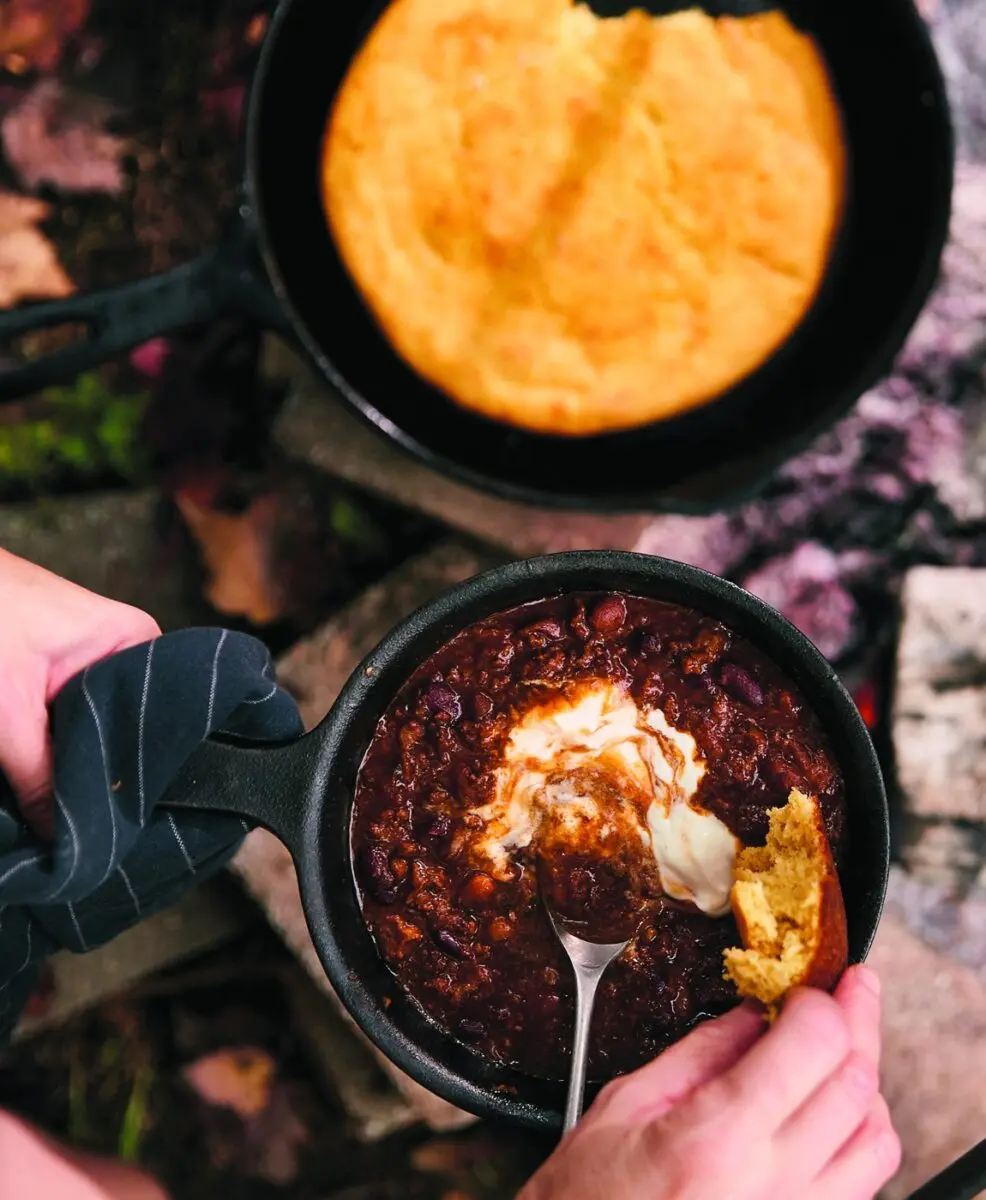
This campfire chili takes three hours over the coals, and I am not going to apologize for it. I could hand you a five-ingredient version you’ll have on the table in twenty minutes. I won’t, because chili is sacred to me — one of the true classics of cowboy fire cooking, and it deserves better than a version that cuts every corner.
My take asks for a few ingredients you’ll have to seek out, sure, but it has never once let me down. On a cool evening, stirring a pot by the fire every so often is about the only job you have all night anyway.
Below is the whole process, in the order I actually do it: the spice mix I grind before I ever leave the driveway, how I rig the fire to hold the pot, the sequence the chili gets built in, and the one shortcut I allow myself. Jump straight to the card if you know your way around a Dutch oven, or stay with me for the why behind each step.
🤠 Why This Campfire Chili Doesn’t Cut Corners
Chili con carne is one of the great classics of cowboy fire cooking, and I think it’s an insult to serve a version that phones it in. So this isn’t a fast recipe — it’s a three-hour one, built the way I’d want it built if I were the one eating it at the end of a cold night. Two cuts of beef instead of one, real dried chilies instead of a jar of chili powder, and enough time on the coals for everything to actually get to know each other.
My one real opinion on the matter: chili con carne is almost never spicy enough. This one is built to have some heat to it — we’re not making a bolognese here.
🔥 The Fire and the Rig
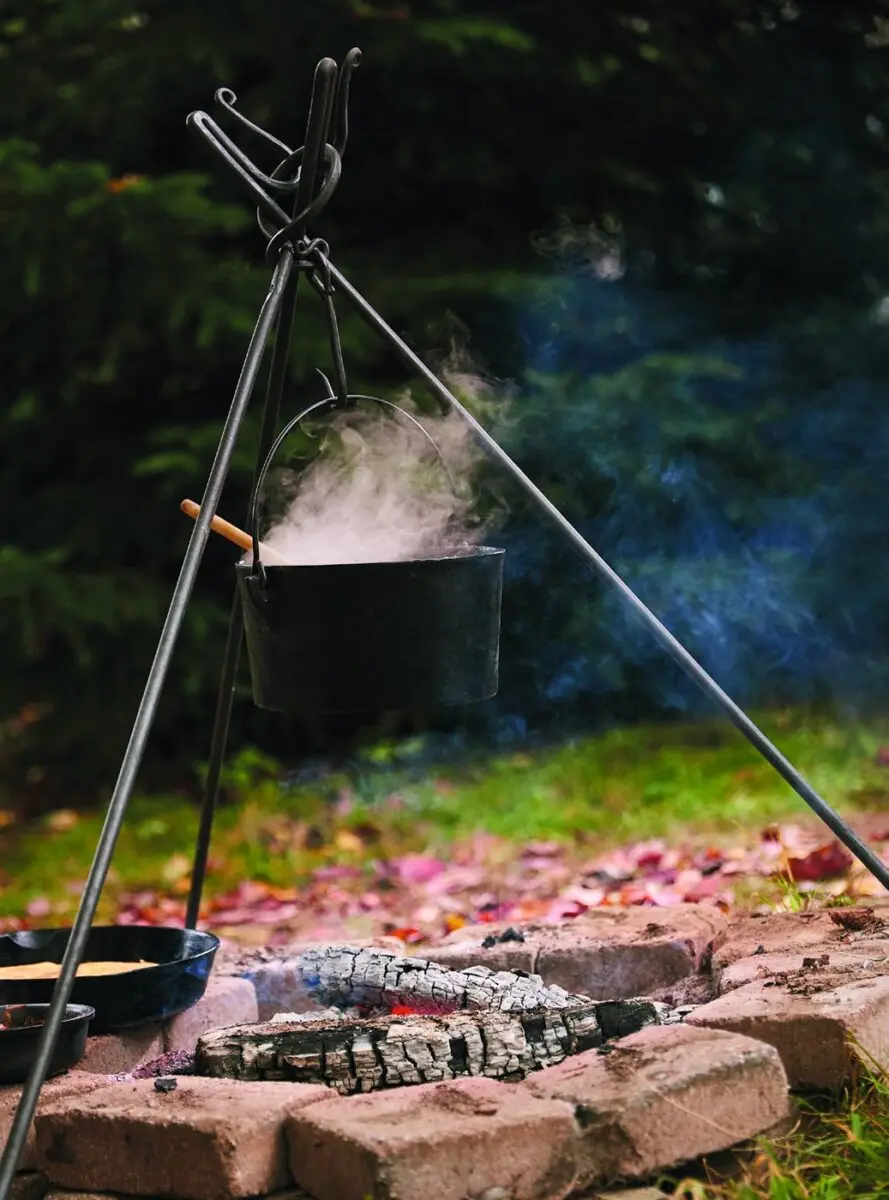
Start your fire at least 45 minutes before you plan to cook, and let it burn down to a bed of good, glowing coals — you want heat you can hold your hand over for a few seconds, not open flame licking the bottom of the pot. Set up a tripod with a hook to hang the Dutch oven if yours has a handle for it, or a solid grate set at least 8 inches (20 cm) above the coals if it doesn’t. Either way, you’re cooking over steady radiant heat for the next three hours, so build a rig that isn’t going anywhere.
🧵 Grind Your Spice Mix Before You Leave Home
This is the one step I do at the kitchen counter, not the fire pit. Combine your dried ancho chilies — seeds and all — with the cumin, and grind them together in a spice mill or crush them in a mortar and pestle until you’ve got a coarse, fragrant powder. Seal it in a bag or a small jar and toss it in with your kit box. It takes five minutes at home and saves you fumbling with a mortar in the dark later, and it means the backbone of this chili’s flavor is already sorted before you’ve even packed the cooler.

🥩 Searing the Beef in Batches
Heat the olive oil in the Dutch oven until it shimmers. Add the diced sirloin tip a few pieces at a time — this is the part people rush, and it’s the part that matters most. Crowd the pot and the beef steams in its own juice instead of browning; work in small batches and you get a real, dark sear with a crust on it. Pull each batch out as it’s done and set it aside. Brown the ground beef the same way, right in the fat left behind, breaking it up as it goes. Ground beef needs to reach the USDA’s safe minimum internal temperature, not just a good sear, before the chili’s done. That fond building up on the bottom of the pot is flavor you cannot get any other way, so don’t scrub it off — you’re about to build right on top of it.
Once the beef is out, soften the onion, poblano, and jalapeño in the same pot. Stir in the garlic and your spice mix and let it turn fragrant for a minute before you add anything wet — that’s the moment the ancho and cumin really wake up.
🌶️ How Much Heat Is Too Much?
On the Scoville scale, heat swings wildly between pepper varieties — and just as wildly between one person’s tolerance and the next. A poblano is barely warm, a jalapeño has real bite, and a chipotle in adobo brings both heat and a deep smokiness that a plain chili powder never will. My advice is to start on the milder end — one jalapeño, not two — and taste as you go, adding more heat later rather than trying to cool an overly hot pot down. You can always add; you can’t take away.
🥦 My One Concession: Canned Beans
Purists will tell you real Texas chili has no beans in it at all. I hear them, and I do it anyway — canned beans, drained, stirred in for the last stretch of the simmer, are the single shortcut I allow myself in this whole recipe. Everything else gets the long way. This is my one concession, and I’m not sorry about it: on a cold night, the extra heft is worth it.
☕ The Espresso in the Pot
There’s a short espresso in this chili, about a third of a cup, and it’s not a gimmick. It goes in with the tomatoes and the broth, and by the time three hours have passed you can’t taste coffee at all — what’s left is a darker, rounder bottom note under the chiles. If you have a stovetop espresso maker at camp, pull a shot straight into the pot; strong brewed coffee does the job too. Leave it out and the chili is still good. Put it in and it tastes like it took all day, which it did.
🍴 The Long Simmer
Return the seared beef and ground beef to the pot along with the chipotle pepper (or the pimentón, if that’s what you brought), then cover it all with the beef broth. In go the crushed tomatoes, the Worcestershire sauce, the salt and — yes — a short espresso. Bring it to a boil with the pot hanging as close to the flames as you can get it, then move it to indirect heat: swing the tripod out, or shift the pot to a quieter corner of the fire. Leave it uncovered and let it simmer gently for about 40 minutes, stirring regularly so nothing catches on the bottom.
Then the beans go in, with the maple syrup and as much Tabasco as you want. From here it’s low heat and patience: stir, taste, adjust, taste again, adjust again, and let it reduce slowly for about two hours, until it sits closer to a thick gravy than a soup and the beef pulls apart with a fork. This is where I stop working and start waiting — I crack open the Pschitt and let the coals do the rest.
Taste it before you call it done. It should be salty enough, deeply flavored, a little smoky from the chipotle, and carrying real heat — not a polite warmth. Adjust with a pinch more salt or a splash more broth if it’s tightened up more than you’d like.
🍴 Serving It Camp-Style
Ladle it straight from the pot into bowls — this isn’t a dish that needs plating. Set out toppings and let everyone build their own bowl by the fire.
- Shredded cheese. It melts into the hot chili almost instantly.
- Sour cream. Cuts the heat if you went heavy on the jalapeño.
- Chopped green onion or cilantro. Freshness against three hours of slow-cooked richness.
- Lime wedges. A squeeze right before the first bite wakes the whole bowl up.
- Cornbread or tortilla chips. Something to scoop with, always.
Cowgirl Chili
Equipment
- 1 Cast Iron Dutch Oven with a handle for hanging over the fire
- 1 tripod with hook (or a sturdy grate) positioned at least 8 in / 20 cm above the coals
- 1 spice mill or mortar and pestle for the ancho chiles and cumin
Ingredients
Chili Spice Mix (Prepare at Home)
- 2 small dried ancho chiles with seeds
- 2 tsp cumin freshly ground
For the Chili
- 2 tbsp olive oil
- 1 lb sirloin tip beef cut into cubes
- 2 lb ground beef medium-lean
- 1 onion chopped
- 1 poblano pepper seeded and chopped
- 1-2 jalapeño peppers seeded and chopped, to taste
- 2 garlic cloves chopped
- 1 chipotle pepper in adobo sauce or 1 tsp pimentón (hot smoked Spanish paprika)
- 1 can (900 ml) beef broth
- 1 can (798 ml) crushed tomatoes 28 oz
- 1 tbsp Worcestershire sauce
- 2 tsp salt if using unsalted or reduced-sodium broth
- 1 short espresso about 1/3 cup
- 1 can (540 ml) red kidney beans 19 oz, drained
- 1 can (540 ml) pinto beans 19 oz, drained
- 1 tbsp maple syrup or sugar, or molasses
- Tabasco sauce to taste
- salt and pepper to taste
To Serve
- cornbread or the bread of your choice
- grated cheese
- green onions chopped
- sour cream
- Tabasco sauce
Instructions
Make it ahead
- Combine the dried ancho chiles (seeds included) with the cumin and grind together in a spice mill, or crush with a mortar and pestle, until you have a coarse, fragrant powder. Seal in a bag and set it aside until you’re ready to cook.
Over the fire
- Build your fire and let it burn down to a bed of good glowing coals, at least 45 minutes before you start cooking.
- Set up a tripod with a hook to hold the Dutch oven by its handle, or a sturdy grate positioned at least 8 inches (20 cm) above the coals.
- Heat the olive oil in the Dutch oven.
- Sear the diced sirloin tip beef in the hot oil, a few pieces at a time so they brown instead of boiling in their own juices. Set the seared pieces aside as you go.
- Brown the ground beef in the same pot, breaking it up as it cooks, then set it aside with the sirloin.
- In the same pot, soften the onion, poblano pepper, and jalapeño pepper(s).
- Stir in the garlic and the chili spice mix and cook until fragrant, about a minute.
- Return the beef to the pot, then add the chipotle pepper in adobo sauce (or the pimentón) and cover with the beef broth.
- Add the crushed tomatoes, the Worcestershire sauce, the salt and the espresso, and stir well.
- Bring it to a boil with the pot hanging as close to the flames as you can get it. Then move it to indirect heat — swing the tripod out, or shift the pot to a quieter corner of the fire — and leave it uncovered. Let it simmer gently for about 40 minutes, stirring regularly so nothing catches on the bottom.
- Add the drained kidney beans and pinto beans, the maple syrup and Tabasco to taste. Keep cooking over low heat, stirring regularly. Taste. Adjust. Taste again. Adjust again. Let it reduce slowly until it reaches the consistency you want, about 2 hours.
- Season with salt and pepper, and serve with cornbread, grated cheese, green onions, sour cream and more Tabasco.
Notes
- Making it at home instead
- Substituting dried ancho chilies
- Using only ground beef
- Knowing when it’s done
- Making the spice mix ahead
- Handling the leftovers
- How spicy the recipe is
❓ Frequently Asked Questions
Can I make this at home instead of over a campfire?
Yes — a heavy Dutch oven on the stovetop works the same way. Sear in batches, build the aromatics, and hold it at the lowest simmer for the same 3 hours.
What if I can’t find dried ancho chilies?
They’re worth tracking down for the real flavor, but a good dried chili blend from the spice aisle will get you a passable version if you’re stuck. It won’t be quite as deep.
Can I use only ground beef and skip the diced sirloin?
You can, but you’ll lose the textural contrast that makes this chili interesting — the diced sirloin holds its shape after 3 hours while the ground beef breaks down into the gravy. It’s worth the extra cut.
How do I know when it’s actually done?
The beef should give easily when you press a piece with a spoon, and the liquid should have reduced into a thick gravy rather than a soup. If it still looks thin after 3 hours, uncover it fully and let it reduce another 20 to 30 minutes.
Can I make the spice mix ahead in bulk?
Absolutely — I grind a bigger batch of ancho and cumin at home and keep it in a sealed jar for the next few camping trips. It stays fragrant for a couple of weeks.
What do I do with leftovers?
Chili is one of those dishes that’s better the next day. Cool it, keep it covered in the cooler or fridge, and reheat gently over the fire or on the stove — it may need a splash of broth or water to loosen back up.
Is this recipe very spicy?
As written, it has real but manageable heat. Use one jalapeño instead of two and the milder pimenton option instead of chipotle if you want to keep it gentler, and add more of either if you like it hotter.