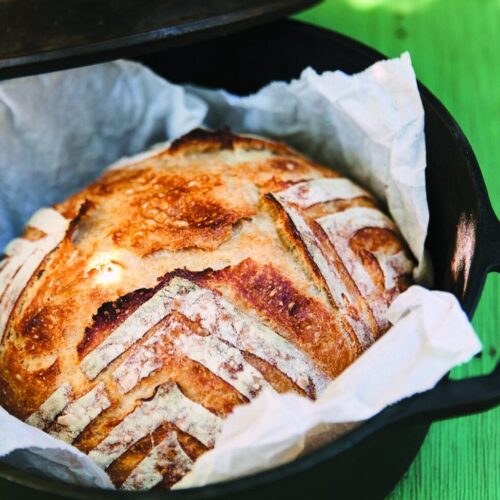
Dutch Oven Bread
A slow-fermented, no-knead bread mixed at home and baked to a crackling crust in a cast iron dutch oven buried in charcoal briquettes — a technique that works just as well over a backyard fire pit or fireplace as it does at a campsite.
Equipment
- 1 cast iron dutch oven (at least 3 L / 3 qt) with a tight-fitting lid
- 29 charcoal briquettes more or less depending on the size of your dutch oven
- 1 chimney starter
- 1 long fire tongs for moving hot briquettes
- 1 sheet of parchment paper
- 1 kitchen scale
Ingredients
For the dough
- 350 g water
- 1/2 tsp (1.5 g) active dry yeast or instant yeast or 1 tsp (3 g) fresh baker's yeast
- 500 g unbleached white flour or a blend: 420 g white flour, 40 g rye flour, 40 g whole wheat flour
- 2 tsp (10 g) salt ideally sea salt
Instructions
Make it ahead
- Set a large bowl on a kitchen scale. Pour in the water, then add the yeast, the flour (or flour blend), and the salt.
- Combine with a spatula until you have a fairly uniform, shaggy dough. A quick knead won't hurt, but it isn't needed for this recipe to work.
- Cover the bowl with plastic wrap or a shower cap and let it rest at room temperature for 4 to 6 hours.
- Move the bowl to the fridge. Cold dough is easier to shape, and the slow, cold fermentation gives a more pronounced flavor and a more open crumb. You can mix the dough at home and let it ferment in the fridge for up to 3 days ahead of time.
Shape and Let Rest
- Turn the dough out onto a floured surface and fold it over on itself. Shape it into a ball using a dough scraper or by rotating it against the counter, flouring as needed.
- Transfer the ball to a square of parchment paper. Dust the top with a little flour and cover with a clean kitchen towel. Let it rest 2 to 3 hours at around 70°F (21°C) — about 45 minutes if it's very hot out, longer if it's cold.
Build the Coal Bed and Bake
- About 30 minutes before baking, light 29 charcoal briquettes in a chimney starter and tip them into the fire. Let them build into a pyramid until lightly ashed over.
- With tongs, spread 10 briquettes over an area about the width of your dutch oven and set the pot, lid on, on top. Arrange the remaining 19 briquettes on the lid and let the pot preheat.
- Cut the parchment paper close around the dough ball. Score the top a few times with scissors or a serrated knife so the bread has room to expand, then use the parchment as a sling to lower the dough into the dutch oven without touching the hot pot. Put the lid back on and reposition the 19 briquettes.
- Every 10 minutes, give the dutch oven a quarter turn to even out hot spots from the coals.
- Bake 35 to 40 minutes. The bread is ready when it reaches 195°F (90°C) at the center, or when tapping the bottom produces a hollow sound.
- If the bottom starts to burn, pull the dutch oven off the heat and finish baking with only the briquettes on the lid — the hot cast iron acts like a mini oven on residual heat.
- Lift the bread out of the dutch oven, remove the parchment paper, and set it on a rack to cool.
Notes
Scaling for a different pot. This briquette count (29 total: 10 under, 19 on the lid) is calibrated for a 10-inch (25 cm) dutch oven at around 450°F. A smaller pot needs fewer briquettes and a larger one needs more — roughly a third underneath and two-thirds on the lid holds up across sizes, but watch the bread, not the clock.
No campfire, no problem. A wood-fired oven or a regular kitchen oven bakes this bread just as well: preheat to 450°F (230°C) with the covered dutch oven inside, then bake covered 35 to 40 minutes and check for the same 195°F (90°C) internal temperature.
Make it days ahead. The dough can be mixed and left to ferment in the fridge up to 3 days before you plan to bake it, which makes this one of the few truly make-ahead breads for a trip.
If the bottom burns. Pull the dutch oven off the direct heat and finish with briquettes on the lid only — the hot cast iron keeps cooking gently without adding more heat underneath.
Don't waste the leftovers. Day-old bread makes excellent croutons, seasoned breadcrumbs, French toast, or pan con tomate.
See the frequently asked questions
- Skipping the fridge and rising at room temperature
- What size dutch oven you need
- Why the pot needs to preheat first
- Fixing uneven browning on one side
- What to do if the bottom burns
- Whether you need a thermometer
- Baking it without a campfire at all
- Doubling the recipe for a bigger group
- Using cups instead of a kitchen scale